Wilkes-Barre, PA · Garage Door Service
Why So Many Wilkes-Barre Garage Doors Fight the Cold
Most Wilkes-Barre homes date to 1938-1985, before modern insulation codes existed. Here's what that older housing means for your garage door in severe cold.
- Repairs & new doors
- Springs & openers
- Serving 8 nearby communities
How Local Conditions Play In
Wilkes-Barre sits in a climate band the federal data marks cold and severe, and the housing stock here backs that up without needing a thermometer. Across this service area the typical house went up between 1938 and 1985, with the median build year landing around 1959 - and that pattern holds across 41 named areas we cover, not just one or two streets. Towns a few minutes out, like Kingston a mile away or Edwardsville at two miles, carry the same age of housing, so the garage doors on those blocks are working against the same problem.
A door built or installed to match a house from 1959 was never built to an insulation standard, because that standard didn't exist yet for residential garage doors. What you get is a steel or wood panel with no foam core, hung on hardware sized for a lighter door, in a region where winter cold sits on that door for months at a time. The door isn't failing. It's doing exactly what it was built to do - which just isn't much, by today's expectations.
When to Call Someone
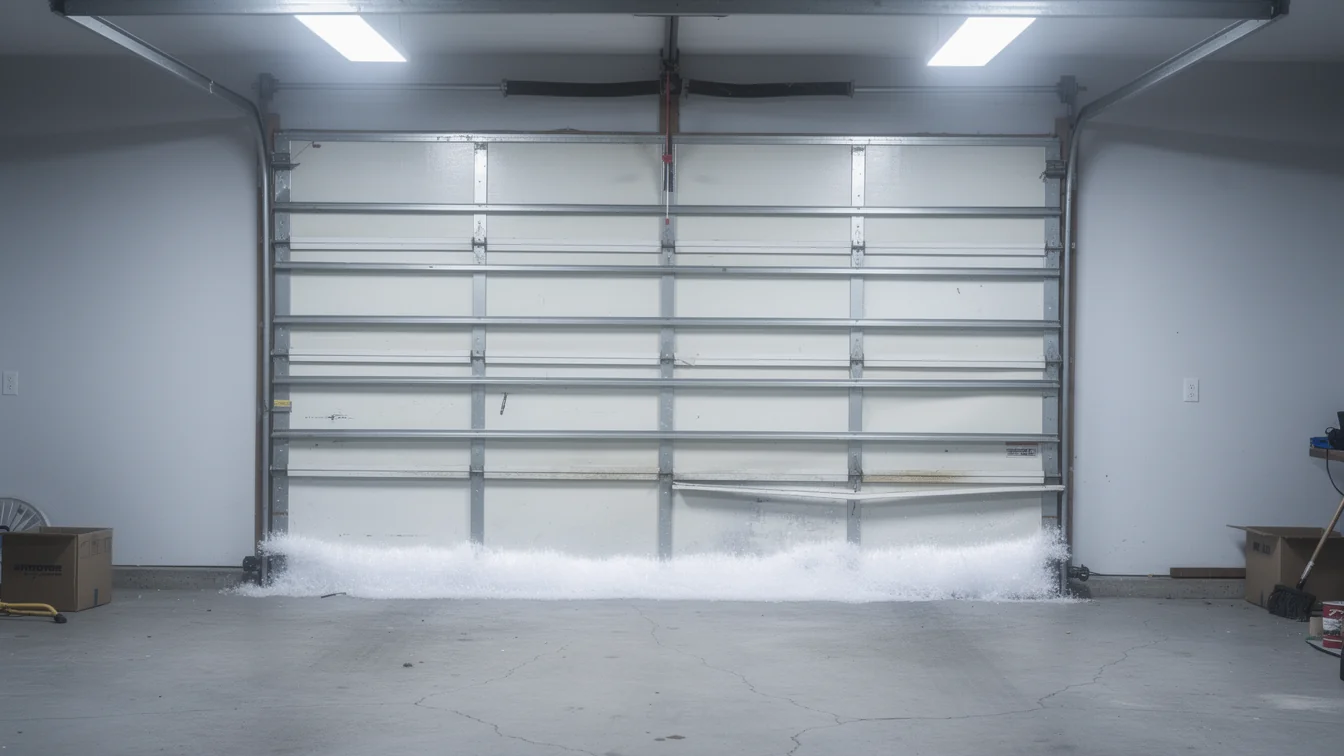
The tell isn't usually a door that won't open. It's a door that opens fine but leaves a cold stripe across the garage floor, or frost forming on the inside face of the panels overnight. If you can see daylight at the bottom seal on a still day, or feel air moving along the side tracks when the wind picks up, that's the original panel design showing its age - not a new problem, just an old one you're finally noticing in a cold stretch.
Call sooner rather than later if the cold is also doing mechanical damage: a torsion spring that's gone brittle and snapped, hardware that's rusted at the bottom bracket from meltwater sitting on the slab, or a track that's pulled out of alignment because the door's heavier than the opener was ever set up for. Those are jobs, not maintenance. A door that's merely cold is a comfort issue. A door with a broken spring or a track pulling loose is a safety one, and it won't wait for warmer weather to get worse.
What Is Going On
Houses built before insulation rules existed got garage doors built the same way - single layer steel or wood, no foam, no thermal break at the frame. That was standard everywhere in this area through most of the 1938-1985 window that defines the housing stock here, and it wasn't a cost-cutting choice at the time. Nobody was asking for an insulated garage door in 1959 because the idea hadn't become code or custom yet.
What changes is what that means now. A single-skin door in a cold-severe climate transmits temperature straight through, so the garage tracks close to outside air, and anything attached to the house on the other side of that wall - a mudroom, a laundry line, a water line - feels it too. The hardware wasn't oversized for weight it doesn't need to carry, so when ice forms in the tracks or the bottom seal stiffens in the cold, the opener is pulling against resistance it wasn't built for. That's often where the complaint starts: not the cold itself, but the opener straining against a door that's gotten stiff in it.
Leaving It Alone
Not every old door on an old house needs to come out. If the panels are sound, the springs are balanced, and the only complaint is that the garage is cold, a full replacement is a bigger job than the problem calls for - weatherstripping and a bottom seal swap can take care of a surprising amount of that draft for a lot less money. With median household income in this area at $67,482 across roughly 40,562 owner-occupied houses, a full insulated-door replacement is a real expense, and it's fair to ask whether the comfort gain is worth it before committing to one.
Where we draw a line: we don't do whole-garage insulation work, wall or ceiling. We handle the door itself - panels, seals, hardware, springs - and if the cold problem is bigger than the door, that's outside what we take on. If your door is original to a house from the 1938-1985 era and still runs smooth and seals reasonably well, leaving it alone until something actually breaks is a defensible call, not a mistake.
Frequently asked questions
Why does my garage feel colder than the rest of the house even with the door closed?
If your house dates to the common Wilkes-Barre build window of 1938 to 1985, the original garage door almost certainly has no insulated core - that standard didn't exist when it was installed. In a climate marked cold and severe, a single-skin steel or wood panel transmits outside temperature straight through, so the garage tracks close to ambient cold even sealed up.
Is it worth insulating an old garage door instead of replacing it?
Often yes, if the door itself is sound - balanced springs, straight tracks, no rust damage at the brackets. Weatherstripping and a new bottom seal handle a lot of the draft for far less than a replacement door. We don't do whole-garage insulation work, just the door, so we can tell you honestly when a seal fix is enough and when the door itself is the problem.
Why did my old torsion spring snap in cold weather?
Metal gets more brittle as it gets colder, and a spring that's already decades old on a house from the 1938-1985 era has less give left in it to begin with. Cold doesn't cause the break by itself, but it's often the thing that finally does it on a spring that was already near the end of its life.
Related garage door services in Wilkes-Barre
More garage door guides
Book garage door service in Wilkes-Barre
Call now or request a quote - tell us what the door is doing and where you are.