Wilkes-Barre, PA · Garage Door Service
Garage Door Maintenance Across the Wilkes-Barre Area
Garage door maintenance for Wilkes-Barre's pre-1960 housing stock and cold winters. Serving Kingston, Edwardsville, Forty Fort, Plymouth, and the surrounding valley.
- Repairs & new doors
- Springs & openers
- Serving 8 nearby communities
Why This Fails Locally
Most of the housing stock in this service area went up between 1938 and 1985, with a median build year of 1959, and across the 41 named communities we cover the stock skews even older than that median suggests. A door and track system built or last replaced in that window was engineered for a different climate expectation and a different steel gauge than what ships today. That matters here because the region sits in a COLD severe climate band - hard freeze-thaw cycles that work on galvanized hardware, shrink and swell wood jambs, and gum up lubricant that was fine in October and sludge by January. Maintenance on a 1959-era opening isn't the same job as maintenance on a 2015-era opening. The track alignment tolerances are tighter, the spring wire is thinner gauge by modern standards, and the weatherstrip channel was often added after the fact rather than built in. We see the same failure pattern on torsion springs and rollers house after house across Kingston, Edwardsville, Forty Fort, and the rest of the valley - not because owners neglect the door, but because the hardware was never spec'd for 60-plus winters of expansion and contraction. Regular maintenance catches the wear before the cold finishes the job.
The Cost of This Job
We don't have a flat number to post here because the job itself varies with what's hanging on the door - a single torsion spring tune-up is a different scope than a full track and roller service on an older double door. What we can tell you is what drives the cost: the age and gauge of the existing hardware, whether the opener has to come off to get at the track, and how much rust or wood rot the cold winters here have already worked into the jambs. Given the median household income of $67,482 across this service area and roughly 40,562 owner-occupied houses out of 77,563 households, most of what we quote on maintenance calls falls in a range built around keeping an older door running rather than replacing it outright. If a spring or cable has advanced past the point of a tune-up, we'll tell you plainly - sometimes a repair isn't worth doing twice. Ask for a number specific to your door and your address; we won't guess at it in writing.
What Can Go Wrong
On the older stock that makes up most of this area, the common failure starts small: a roller that's gone from steel to worn plastic groove, a cable fraying where it wraps the drum, a torsion spring losing coil tension a quarter-turn at a time. In a COLD severe climate band, that slow wear gets a push every winter - metal contracts, lubricant stiffens, and a door that was merely stiff in November can bind hard enough to strip an opener gear by February. Track misalignment is the other pattern we see often in houses from the 1938-1985 era: the original track brackets were shimmed to a stud layout that's shifted slightly over six decades, so the rollers ride off-center and wear unevenly on one side. Left alone, that uneven wear eventually pulls a panel off true. None of these are emergencies on day one. All of them become emergencies - a snapped spring, a derailed door, a seized opener - if nobody checks them for a season or two.
What You Are Seeing
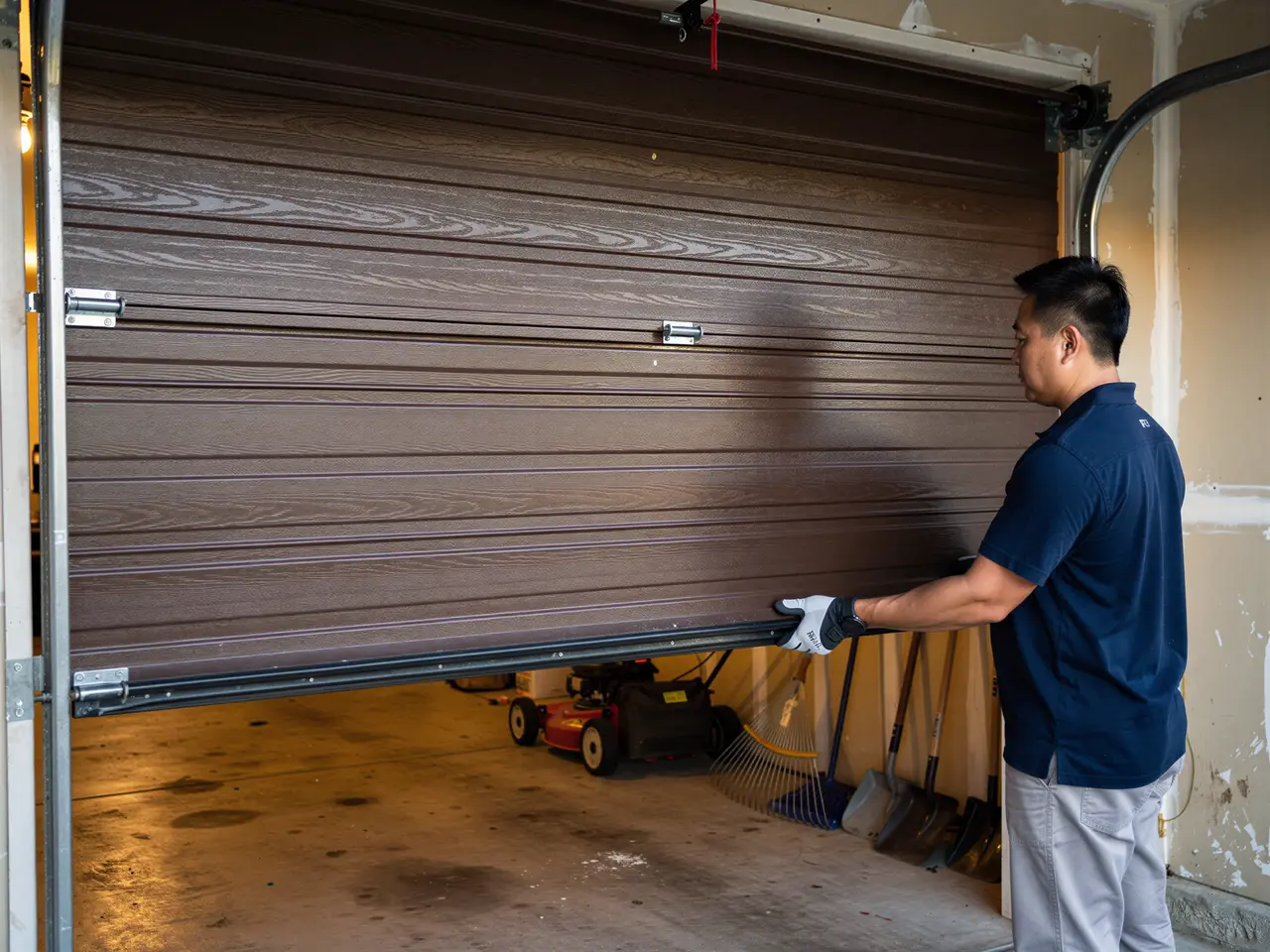
If your door drags, shudders partway through its travel, or needs a shove from the opener to clear the last foot of track, that's wear talking before failure does. A grinding or popping noise on the way up is often a roller or bearing going bad, not the spring itself. A door that's noticeably heavier to lift by hand than it used to be is telling you the torsion spring has lost tension - common on older coils that have never been re-tensioned. Rust streaks on the track or spring coil are a straightforward sign the cold-season moisture cycle is getting into metal that was painted, not galvanized, which was standard on a lot of the pre-1960 builds in this area. None of these symptoms mean you need a new door. They mean the maintenance window is open now, before a cold snap turns a stiff door into a stuck one.
Frequently asked questions
How often should I get my garage door serviced in Wilkes-Barre?
Given the COLD severe climate here and how much of the housing stock predates 1960, once a year before winter is the minimum - ideally fall, before the hard freeze-thaw cycles start working on springs, cables, and track alignment. Older hardware benefits from a second check mid-winter if the door's been sluggish.
Why does my door get stiff every winter even though nothing's broken?
Cold contracts metal and thickens lubricant, and on older torsion springs and track hardware common to this area's pre-1960 housing, that stiffness is usually tension loss or dried-out rollers rather than a single broken part. It's exactly the kind of wear a maintenance visit catches before it becomes a repair.
Is maintenance worth it on an old door, or should I just replace it?
Depends on what the tune-up finds. If the track, drum, and jambs are sound and it's just worn rollers or a spring needing tension, maintenance is the cheaper and faster fix. If the frame's rotted or the spring's at the end of its coil life, we'll say so - replacing twice isn't a favor to you.
Related services
By Neighborhood
Maintenance across the Wilkes-Barre area
We also handle maintenance in these Wilkes-Barre-area suburbs.
Book garage door service in Wilkes-Barre
Call now or request a quote - tell us what the door is doing and where you are.