Wilkes-Barre, PA · Garage Door Service
Garage Door Service for Kingston, PA Homes
Kingston homes mostly date to the early 1970s, later than much of the Wilkes-Barre area. We work on the openers, springs, and tracks that era actually has.
- Repairs & new doors
- Springs & openers
- Serving 8 nearby communities
What You Are Seeing
Most garage doors in Kingston went up with houses built around 1973, which puts this borough a decade or more newer than much of the surrounding service area, where the median build year sits closer to 1959. That gap matters. A 1973 build is more likely to have a double-wide steel door on an extension-spring setup than the single-panel wood doors common on older stock nearby, and the openers, if original, are early chain-drive units rather than the one-piece doors with no opener at all that you'll find on pre-1950 houses a few miles off. If your door is original to the house, you're looking at roughly fifty years on steel rollers, lift cables, and hinges that were never built to run that long. The symptoms show up as a door that drops hard the last foot of travel, a track that's worked loose from the jamb over decades of settling, or an opener that still runs but trips the safety reverse for no clear reason. None of that is dramatic. It's just age catching up with hardware nobody's touched since the Nixon administration.
Time on the Job
We come from Wilkes-Barre, about 6 miles out, so Kingston calls go on the same route as the rest of the area we cover. We don't run a branch here and we won't pretend otherwise - what we can tell you is that most jobs on a door this age are straightforward once we're looking at it, because the failure points on a 1970s steel door are well understood: spring, cable, rollers, opener gearing. What takes longer is anything where the track or jamb has shifted with the house, which is more common here than on newer construction, since the structure itself has had fifty years to move.
What the Fix Involves
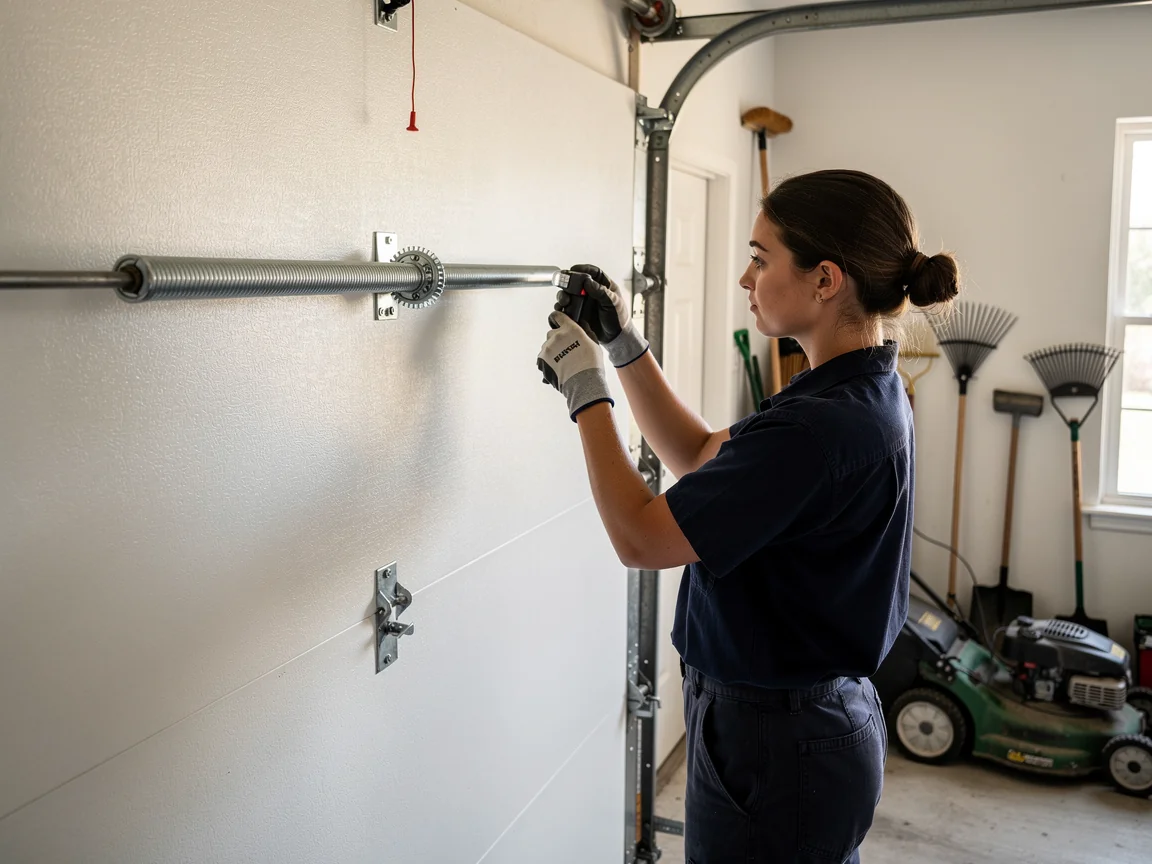
On a typical Kingston call we start by running the door manually, disconnected from the opener, to see what the spring and cable are actually doing without the motor masking it. If it's a broken torsion or extension spring, that's a full stop until it's replaced - these doors are heavy enough that a single spring failure on a double door can let the whole thing drop. If the door tracks fine but drifts or binds, we're usually looking at bent track or worn rollers, which on a house this age are original steel rollers rather than nylon. For opener issues, we check the logic board and the safety sensors before touching the motor itself, since a sensor knocked out of alignment reads the same as a failing opener to most homeowners. We test the balance last, with the opener disconnected, because a door that's out of balance will burn out a new opener just as fast as it burned out the old one.
Parts We Carry
For a house built in 1973, we carry torsion and extension springs sized to the steel doors common from that era, steel rollers and the sealed-bearing replacements for them, lift cables, and standard chain and belt-drive opener components. What we don't stock on the truck are parts for the older one-piece wood doors that show up on pre-1950 construction elsewhere in the area - those take a special order, and we'll tell you that up front rather than have you wait on the truck for something that isn't on it.
What Can Go Wrong
This region sits in a cold-weather climate band with severe winter conditions, and that affects a 1973 steel door differently than it affects newer insulated models. Steel contracts in deep cold, which tightens tolerances on track alignment that's already loosened over fifty years of settling, and that combination is what produces the binding and grinding calls we get worse in January than in July. Lift cables on original hardware are also past any reasonable service life, and a cable that lets go under tension is one of the few failures here that's a real safety issue rather than just an inconvenience - we treat a frayed cable as urgent, not routine.
The Cost of This Job
Kingston's median household income runs close to $81,957, noticeably above the roughly $67,482 median across the wider area we serve, and the borough has about 3,182 households. That doesn't set the price of a spring or an opener - steel and labor cost what they cost - but it does mean replacement, when a door is far enough gone that repair stops making sense, is a call more households here are in a position to make without it being a stretch. We'll always tell you plainly when a repair is worth doing versus when the door's age means you're paying twice.
Frequently asked questions
Is my garage door original to my house if it was built around 1973?
It's possible, especially if no one's mentioned a replacement. A steel door from that era usually shows its age through rust at the bottom panel, pitted rollers, and a spring that's lost tension. If no one in the home's history replaced it, assume the hardware is original and due for inspection.
Do you have a shop in Kingston?
No. We run out of Wilkes-Barre, about 6 miles from Kingston, and cover the borough as part of our service area. We don't keep a local branch here, so we don't quote local response times for Kingston specifically.
Why does my door act up worse in winter?
Steel tightens in cold weather, which can bind an already-loose track, especially on a door that's fifty-some years old and has settled with the house. That's more common here given the area's severe winter climate band than it would be somewhere with milder winters.
Should I repair or replace an original 1970s door?
Depends what's failing. A broken spring or bad rollers on an otherwise sound steel door is worth repairing. If the track is badly bent, the panels are rusted through, or you're replacing the third part in two years, replacement usually costs less over time than chasing repairs.
More garage door services in Kingston
Book garage door service in Wilkes-Barre
Call now or request a quote - tell us what the door is doing and where you are.