Wilkes-Barre, PA · Garage Door Service
What We Check First on a Wilkes-Barre Service Call
A Wilkes-Barre tech's first-look checklist, built around 1938-1985 housing stock and severe cold winters that hit original torsion hardware hardest.
- Repairs & new doors
- Springs & openers
- Serving 8 nearby communities
How Local Conditions Play In
Most of the houses we get called to in Wilkes-Barre and the neighborhoods around it - Kingston, Edwardsville, Forty Fort, Larksville - went up between 1938 and 1985, with the median landing around 1959. That means a lot of garages still carry the original door hardware, or a replacement door bolted onto decades-old track and jamb framing that was never squared for anything newer. The first thing a tech does is look at the vintage of the install before touching a single bolt, because a 1959 header is not built the same as one framed in 1985.
The climate band here is classified as cold and severe, and that matters more to a garage door than people expect. Steel contracts in deep cold, and on an unheated garage the overnight temperature swing is often the biggest stress a torsion spring sees all year - bigger than the lifting load itself. So before a tech checks the spring wind or the cable tension, they're reading the slab for frost heave at the threshold and checking whether the bottom seal has gone stiff and cracked rather than just worn out. On an older slab in this area, that's often the real story, not the door itself.
When to Call Someone
Call when the door is off-balance - it drifts down on its own, or an opener strains and reverses partway through a cycle. On pre-1960 stock that's usually a spring that's lost tension gradually over a long cold stretch, not a sudden snap. Call sooner rather than later if you hear a new scrape or thud at the same point in the travel every time; that's a track or roller issue, and on older framing it tends to get worse fast once the track starts pulling loose from the jamb.
Don't wait on a door that won't seal tight at the bottom in winter. With this climate band, a gapped seal isn't just a draft problem - it lets moisture and freeze-thaw cycling work on the slab and the bottom panel both. We'd rather get out and look at it in October than get the call in January when the seal's frozen to the concrete.
We don't troubleshoot over the phone past the basics. If you can describe what you're seeing and hearing, we can usually tell you whether it's safe to keep using the door until we arrive, but anything involving the spring itself is a look-in-person call, not a guess-from-a-description call.
What Is Going On
On a house from the 1959 era, the most common thing we find is original or early-replacement torsion hardware sized for a lighter door than what's hanging on it now - somebody swapped in a heavier insulated panel years back without upsizing the spring. Under normal load that limps along fine. Under a hard cold snap, with the steel contracted and stiffer, it's the difference between a spring that lasts another winter and one that lets go on a Tuesday morning.
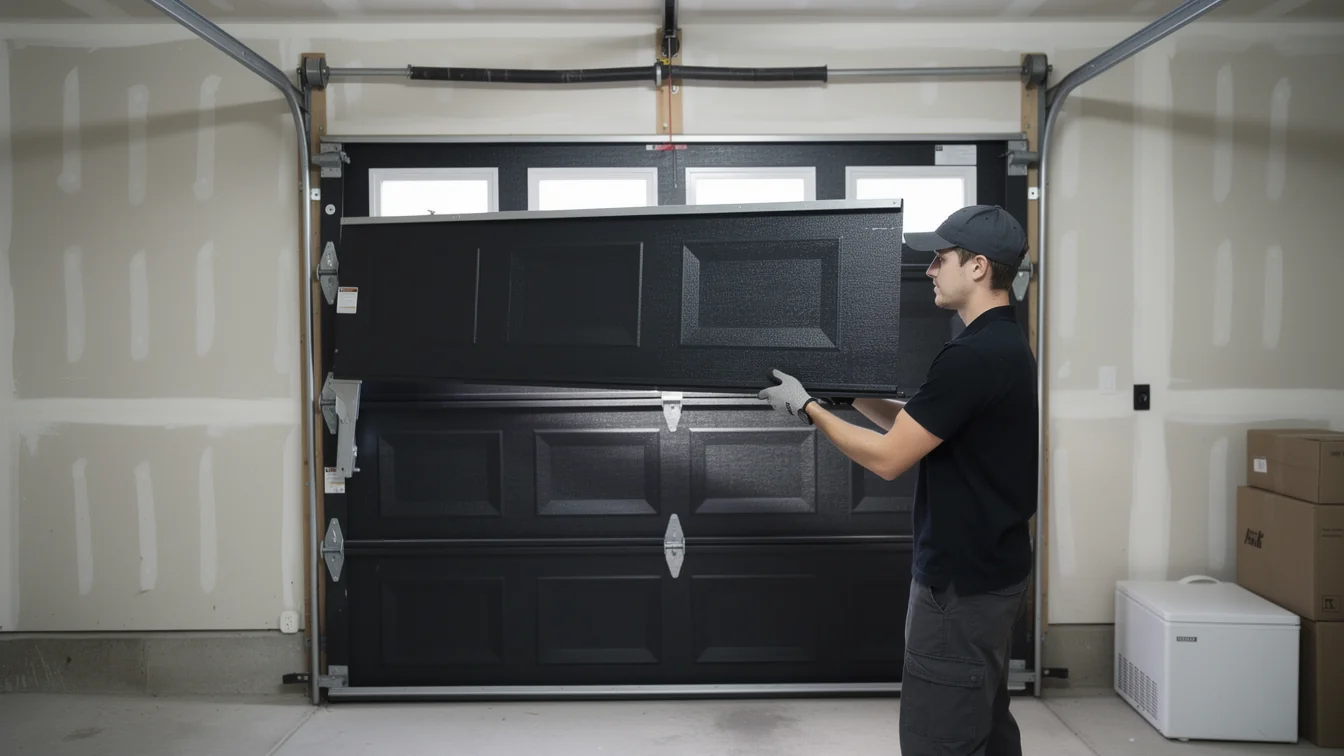
We also see a lot of play in the roller brackets on houses of this vintage, because the jamb lumber itself has shifted over sixty-plus years and the lag screws no longer bite the same wood they did originally. That shows up as a door that rattles more than it used to, or rollers that walk out of the track on one side.
It's less often the opener. Openers get replaced on a normal consumer cycle regardless of house age, so by the time we're out, most homes already have a newer unit. The hardware tied to the structure - spring, track, jamb bracket - is what carries the age of the house.
Leaving It Alone
Not everything needs a service call. A door that's a little slow to close in a cold snap but still seals and still reverses properly on contact is often just stiff grease, not a failing part - we'd rather you lube the track and rollers yourself than pay a truck fee for that. And a cosmetic ding on an older panel that still tracks straight and balances correctly isn't worth replacing on its own; we'll tell you to live with it until something else on that door needs attention, then address both at once.
Where we won't talk you out of a call: anything involving the torsion spring under tension. That's not a DIY judgment call anywhere, let alone on hardware that's been loaded and unloaded by sixty winters of cold contraction. The honest limitation here is that we can't always tell from a phone description whether a slow or noisy door is cosmetic wear or an early warning sign on aging hardware - some of that only shows up once a tech has hands on the spring and track in person.
Frequently asked questions
Why does my garage door act up more in winter here?
Steel hardware contracts in cold, and Wilkes-Barre's winters sit in a climate band classified as severe. On a house with original or early torsion hardware from the 1938-1985 building stock common here, that contraction adds real stress right at the point the spring is already weakest, which is why problems tend to show up on the coldest mornings rather than gradually.
Is it normal for an older Wilkes-Barre house to have the original garage hardware?
Yes. Most homes in this area were built between 1938 and 1985, median around 1959, and a lot of garages still run on hardware from that era even if the door panel itself was replaced later. A tech checks the age of the track and spring separately from the door for exactly this reason.
Should I replace or repair an aging door?
It depends on what's actually failing. If the track and jamb hardware are sound and it's just the spring or a seal, repair makes sense. If the jamb lag points have worn loose from decades of use, as we see often in this area's older housing stock, repair tends to be short-lived and replacement of the hardware mount is the better call.
Related garage door services in Wilkes-Barre
More garage door guides
Book garage door service in Wilkes-Barre
Call now or request a quote - tell us what the door is doing and where you are.